History
Midas has primarily been developed by the PSI and TRIUMF labs. Development started in 1993, and continues to this day.
In the early '90s, based on a previous Data Acquisition system running under MS-DOS with network capability (HIX), Dr. Stefan Ritt at Paul Sherrer Institute (PSI, Switzerland) started coding a new set of applications which would be OS independent. At that time, OS such as VMS, ULTRIX, VxWorks and Windows were available.
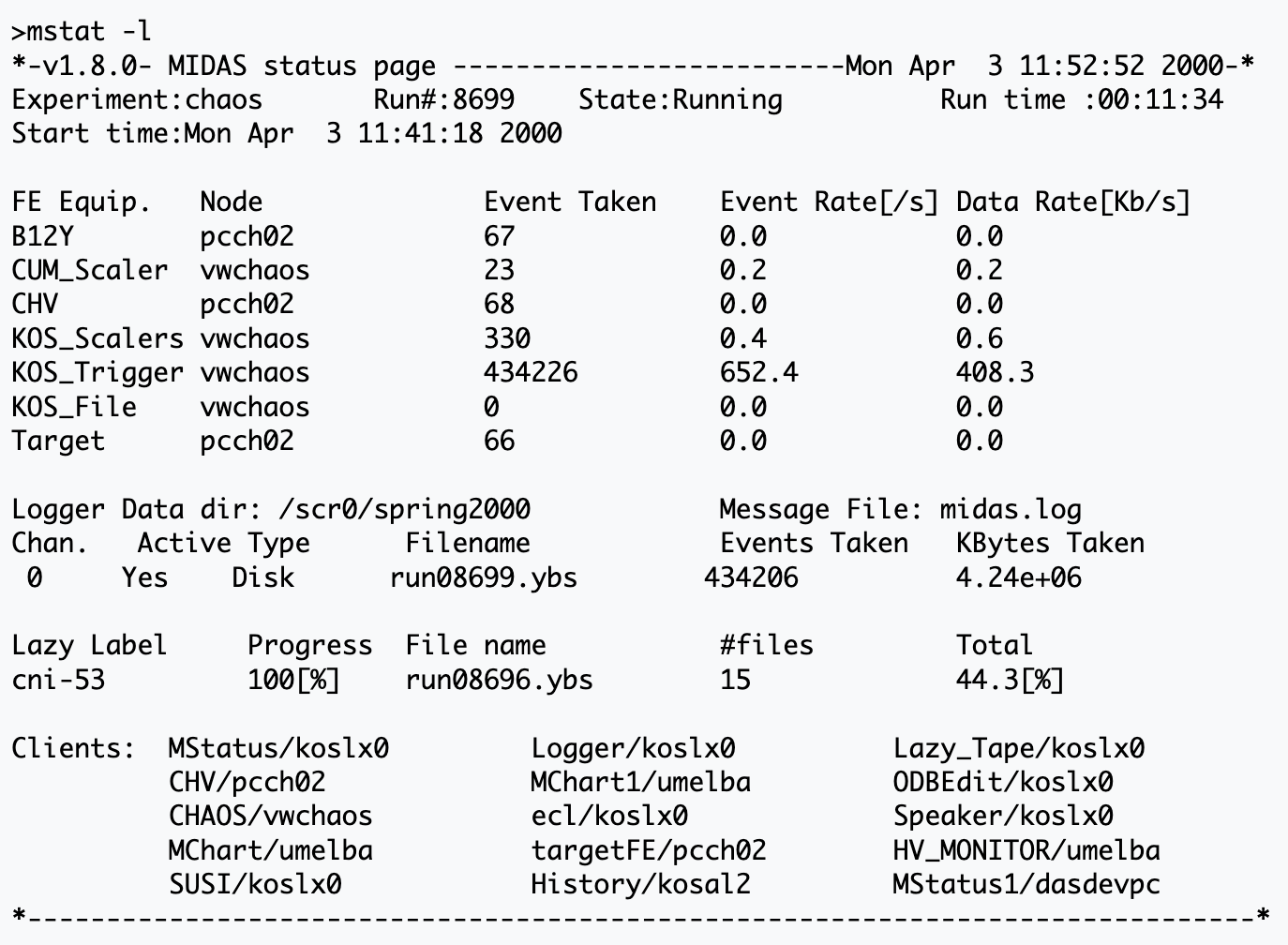
The first deployment of midas was for the "Canadian High Acceptance Orbital Spectrometer" (CHAOS) experimental facility at TRIUMF (Canada). Network-based, the data were collected from a VME processor running VxWorks (collecting CAMAC, FastBus & VME data) and sending them to a backend computer running VMS and later ULTRIX.
Since then, midas has evolved to solve more and more experimental needs, in-keeping with its goal of being the "Maximum Integrated Data Acquisition System". The overarching philosophy of midas is to support as many devices as possible, as efficiently as possible, using as few external dependencies as possible.
 |
 |
 |
|---|---|---|
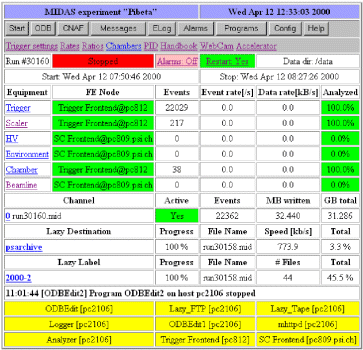
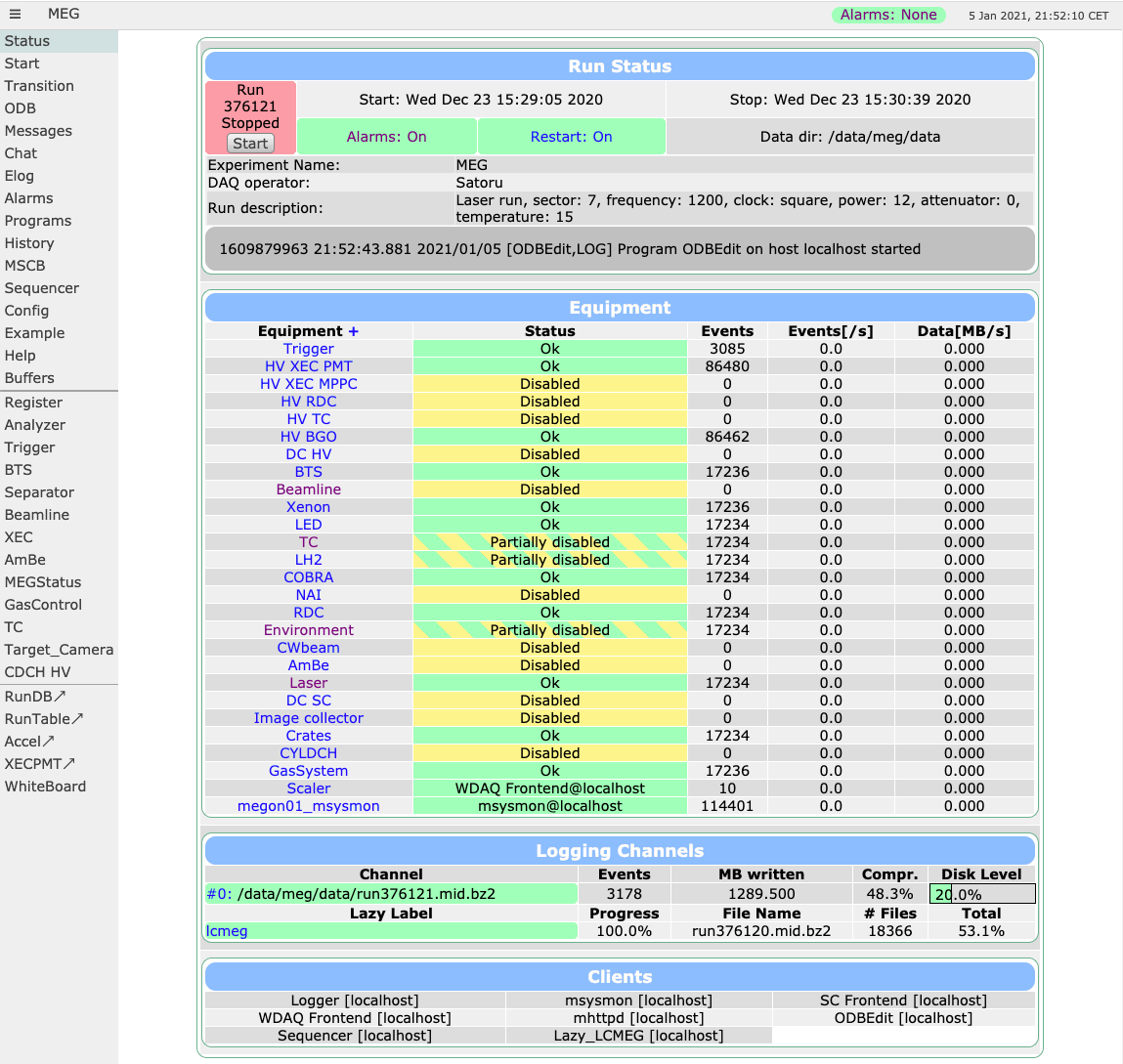
| 2000 | 2008 | Modern day |
Evolution
- 1993 - midas project started by Stefan Ritt at PSI
- 1996 - TRIUMF joins, spearheaded by Pierre-Andre Amaudruz. At this point midas supports frontends, data-logging and data analysis.
- 1997 - History system added for logging time-series data
- 1998 - Web interface created (previously was just command-line tools)
- 1998 - Code repository moved from CVS to SVN
- 1999 - Alarm system added
- 2003 - ROOT support added
- 2008 - SQL databases add as a backend option for the history system
- 2011 - Sequencer added to support scripting
- 2013 - Code repository moved from SVN to git
- 2015 - JSON interfaces added
- 2017 - Start of migration to "modern web" interfaces for everything
- 2019 - Migration from C to C++
- 2019 - Python support added
- 2020 - C++ "map-like" ODB interface added
- 2025 - Sequencer gets support for Python syntax
Experiments using midas
Midas is deployed on all major experiments at TRIUMF and PSI, and is used around the world in over 80 locations.
These experiments range from a teaching lab reading one CAMAC crate at less than 50 kB/s, to large systems with dozens of frontends on many computers, such as T2K and Muon g-2. Muon g-2 processed 20 GB/s of raw data with GPUs, and wrote 200 MB/s to disk. ALPHA-g reads 72 readout boards over 10 Gb/s Ethernet at about 1 GB/s (see Performance for how).
Some example experiments are:
-
μ muons
-
ν neutrinos
-
π pions
-
dark matter
- Dark matter search: DEAP (Sudbury, Canada)
- Dark matter search: Darkside-20k (LNGS, Italy)
- Dark matter search: SuperCDMS SNOLAB (Sudbury, Canada)
-
anti-matter
- Trapping antihydrogen atoms: ALPHA and ALPHA-g (CERN, Switzerland)
-
nuclear
-
materials science (CMMS)